
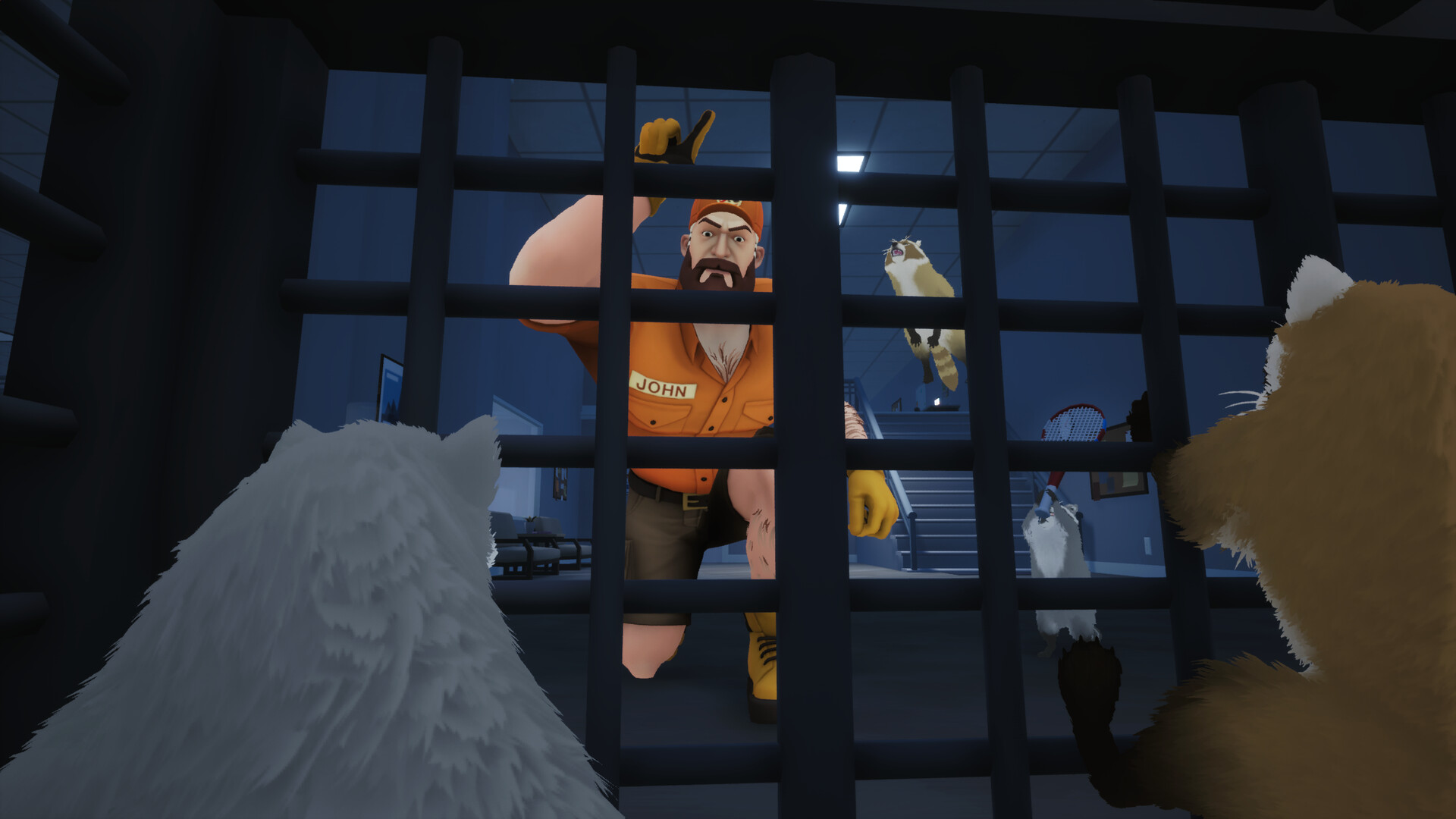
Dumpster Gang co-op is one to four players, online. Everyone shares the same job, the same loot pile and the same Exterminator. There is no competitive mode and no separate co-op campaign.
A session runs in four phases, and every phase has a co-op wrinkle.
Phase 1: scout and split up
The job starts with a mission list. Some entries are simple mischief — tip the bins over, block the toilet, brew a coffee — and some are about volume, like hauling a set amount of junk back to the burrow.
With four players, the efficient move is to split: two on objectives, two on hauling. With two players, everything is sequential and the noise budget is tighter. Solo, there is nobody to trade noise with, so every broken window is yours to answer for.

Phase 2: make noise, get noticed
Almost every action makes sound. Breaking a window, dropping a metal bin, throwing a chair through a fence — the Exterminator hears all of it and comes to look.
This is where co-op changes the game rather than just adding bodies. One player can deliberately make noise in the garden while another empties the kitchen. That is not a tutorial mechanic; it is the natural result of the systems, and it is the reason the game is better with three friends than alone.
Phase 3: the cage
When the Exterminator catches a raccoon, that raccoon goes into a cage. The job does not end. The rest of the gang has to reach the cage and open it, usually while the Exterminator is still patrolling nearby.
The rescue is the best-designed pressure in the game:
- It costs time the mission list is counting.
- It forces the group to move together, which is loud.
- It can fail, and a second capture during a rescue is a common way for a job to fall apart.
The job carries on while someone is in the cage, so the rest of the gang keeps working with one fewer pair of paws until the rescue lands.
Phase 4: carry the haul home
Loot only counts once it reaches the burrow connected to the yard. Carrying is deliberately awkward: heavy objects slow you down, block your view and can be dropped or thrown.
This is the phase where teams argue. A raccoon carrying a sofa cannot climb, so somebody has to clear a route, and the raccoon who took the shortcut through the fence is now explaining themselves.
What "shared" means in practice
The objectives are shared, the loot pool is shared and the hideout is shared. The game is not built around individual inventories or competitive scoring, and the publisher's own description frames betrayal and accidents as part of the job rather than as griefing.
Solo play is fully supported, and the missions, loot and Exterminator are all still there. What disappears is the division of labour: one raccoon makes the noise, carries the loot and answers for both, which turns the same job into a slower, quieter run.
The first ten minutes of a session
A job starts quiet. Four raccoons drop into a level with a mission list and nothing chasing them. The first two minutes are the most valuable of the run, because they are the only ones where nobody is being hunted.
Use them for three things: find the burrow and the route back to it, find the food, and decide who is doing which objective. Teams that skip this step end up doing it later, one raccoon at a time, while the Exterminator walks the corridor.
What to do when somebody is caged
The instinct is to run straight at the cage. The better sequence is: stop making noise, move as a group, and clear the patrol before touching the lock. A rescue attempted while the Exterminator is still in the room usually produces a second cage.
If two raccoons are already caged, the job is effectively over. That is not a failure state the game punishes with a screen — the remaining players simply cannot finish the objectives and extract alone, and the run ends in the ordinary way.
The burrow is the map's centre of gravity
Every route decision comes back to the burrow in the yard. It is where loot counts, where the job ends, and the only fixed point in a level that otherwise lets you approach from any direction.
Teams that treat it as a landmark rather than a destination do better. Knowing which window is closest to the burrow, and which fence line leads to it without passing the patrol route, turns the final carry from a panic into a plan.
Setting up a good group
Pick roles before the first bin. A hauler, a scout and a noise-maker is a better composition than four generalists, especially in the farm.
Agree on the rescue rule. Either everyone drops what they are doing to help, or nobody does. The middle ground wastes the most time.
Play the farm with four. It is the widest demo area and the one that benefits most from a full gang.
No split screen
Co-op is online only. Two players on one machine is not a supported mode, and there is no announced couch play.