
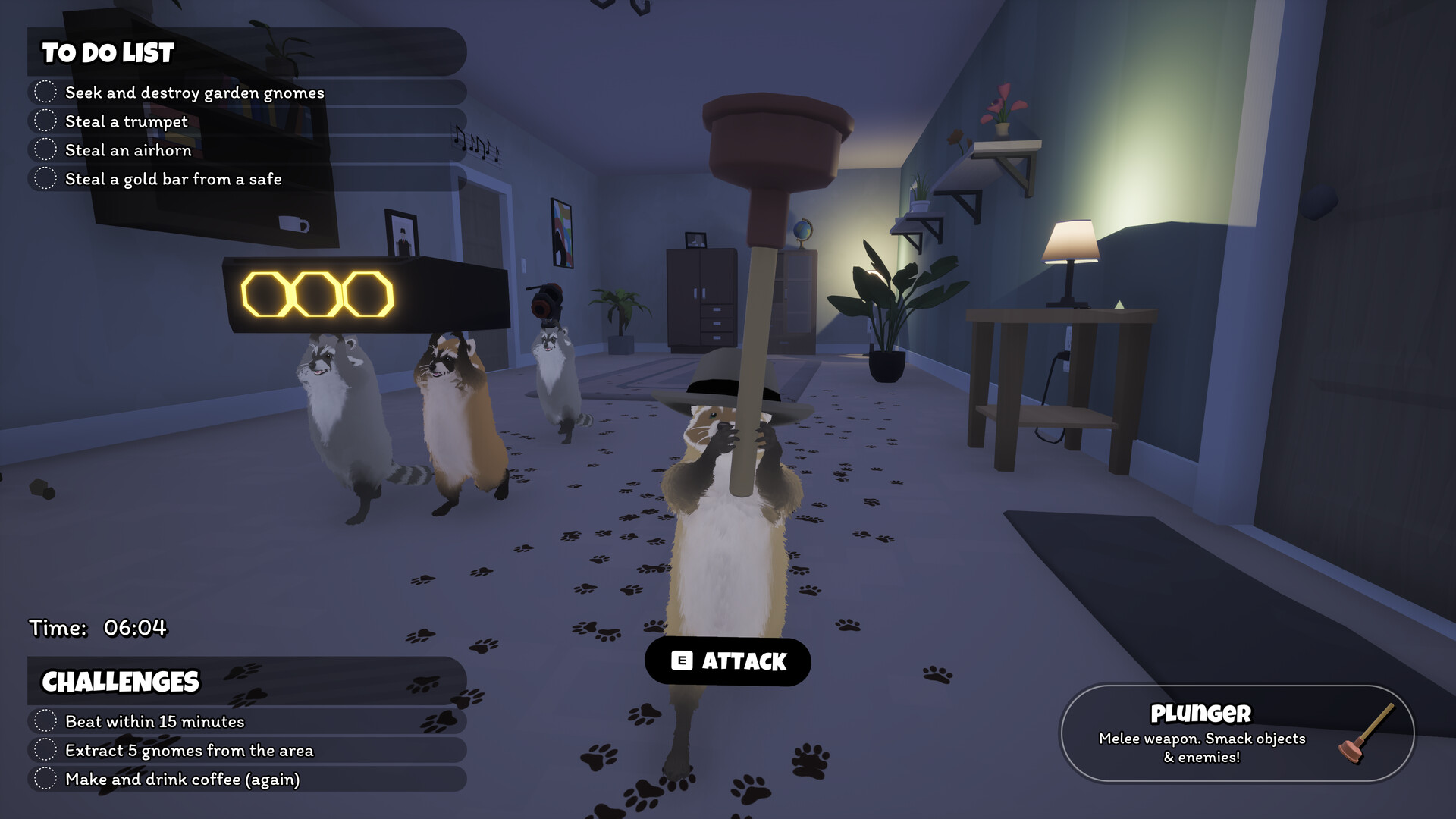
Dumpster Gang is a heist game where the getaway is the hard part. You enter a house, a farm or a camp, complete a list of mischief objectives, carry the loot back to the burrow in the yard and leave. The Exterminator patrols the whole time, and everything you break tells him where you are.
The first job is easiest to learn in the demo's suburban house, because it has indoor and outdoor space, a garden to ruin and one patrol route.
Step 1: learn the movement before you touch anything
Three moves carry the whole game:
- Sprint, for open ground and for the run home.
- Wall climb, which turns fences, drainpipes and house walls into routes. It is usually quieter than a door.
- Vents, which connect rooms that have no other path between them.
Raccoons are small, and the level design rewards that. A gap a human cannot use is a shortcut. Before you start smashing things, walk the perimeter and find the vertical route in and the vertical route out.
Step 2: eat, because food is stamina
Food raises stamina. It is scattered through the levels — in kitchens, in bins, in the farm's outbuildings — and it is the resource that decides how long you can sprint, climb and carry.
Treat it as ammunition rather than decoration. A raccoon at low stamina cannot outrun a patrol, and the run home with a sofa is exactly when the sprint bar matters.
Step 3: do the objectives in a noise order
The mission list mixes quiet objectives with loud ones. The order matters more than the speed:
- Quiet objectives first — anything indoors, anything that does not require breaking.
- Loud objectives second — bins, windows, the toilet, anything that makes a noise the patrol will investigate.
- Loot last, because carrying slows you down and you do not want to be slow while the Exterminator is already looking.
A common first-job mistake is starting with the loudest objective, then trying to do careful work while a man with a catchpole walks the corridor.
Step 4: when the noise lands, move away from it
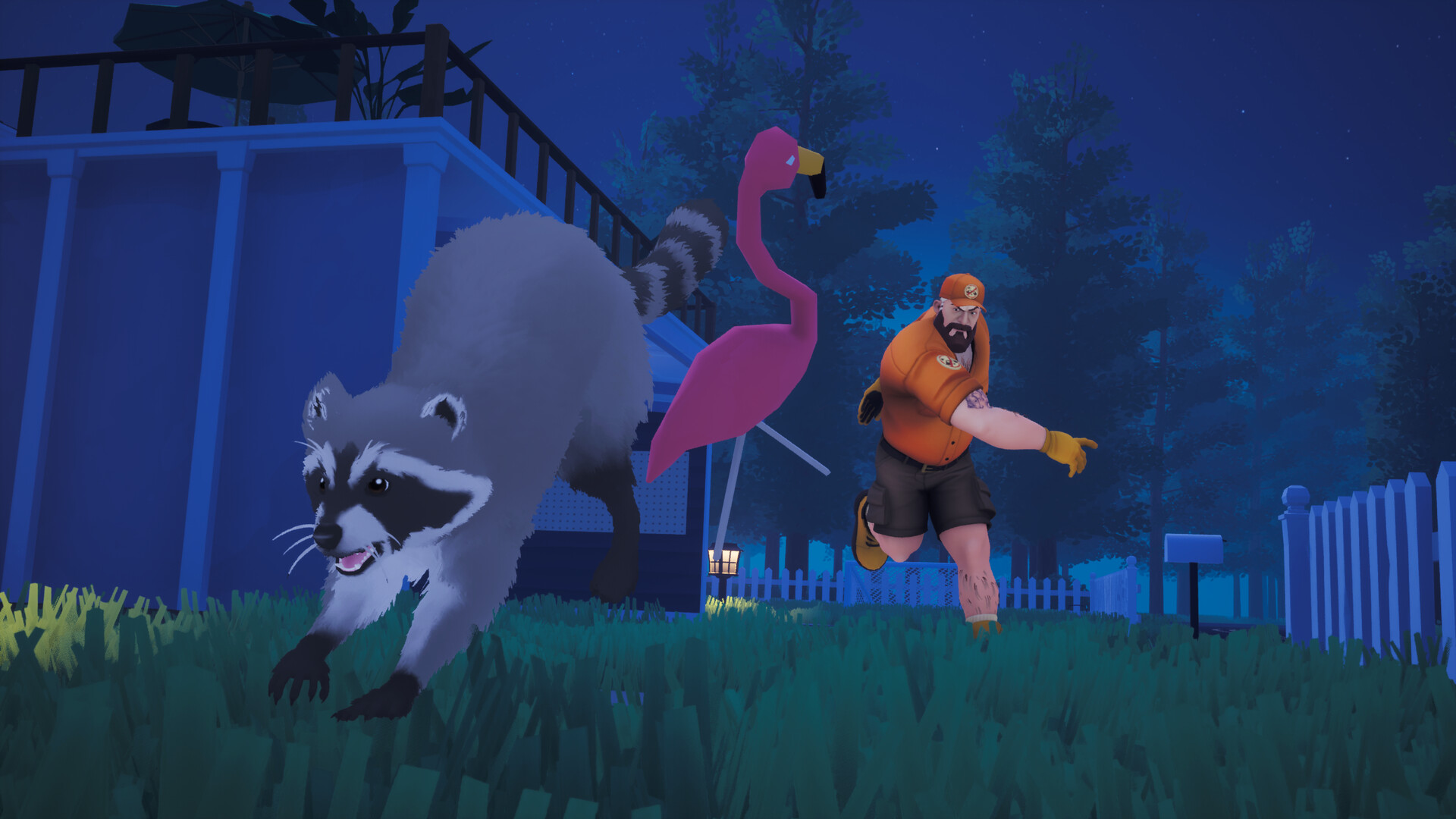
The Exterminator does not teleport. He walks to the noise and searches the area around it. That creates a simple, reliable tactic: make noise in one part of the map, then work in another.
In co-op this becomes the whole game. One raccoon tips bins in the garden while the others empty the kitchen. The patrol commits to the garden, and the loot leaves through the back.
Step 5: the cage, and how to open it
Getting caught does not end the run. The caught raccoon goes into a cage, and the rest of the gang has to reach it and open it.
Three rules make a rescue work:
- Go together. A solo rescue usually ends with two cages.
- Clear the patrol first. The Exterminator stays near the cage he just filled.
- Accept the cost. The objectives pause, the timer does not. A rescue is always a trade.
Step 6: carry the haul to the burrow
Loot only counts when it reaches the burrow connected to the yard. Carrying is deliberately awkward: heavy items slow you down, block your view and can be dropped.
Plan the route before picking something up. A raccoon carrying a sofa cannot climb, so the route home has to be on the ground, and the ground is where the patrol walks.
Step 7: leave
The job ends when the objectives are done and the loot is home. Getting out is a route decision, not a combat decision: the game gives you throwing and a swing with a stick, and both are for escaping rather than winning a fight.
The mistakes that end jobs early
Starting loud. The first broken window sends a patrol into the room you are working in, and every objective after that happens with someone walking nearby.
Carrying too early. Loot is heavy and slow. Picking up a sofa before the objectives are done means doing the rest of the job at half speed, in the open.
Splitting up without a meeting point. Four raccoons in four corners of a farm is efficient until someone is caged, and then nobody is close enough to help.
Ignoring food. Stamina is the resource that decides whether the run home is a sprint or a stumble, and it is scattered around the level for free.
The rescue checklist
When a cage appears, the sequence that works is short: stop making noise, converge on the cage, deal with the patrol that is still nearby, then open it. Two raccoons should be present for the open, because a second capture during a rescue is how a clean job becomes a lost one.
The three habits that separate a clean job from a messy one
Walk the route first. Thirty seconds of climbing around the outside saves a rescue later.
Spend food early. Stamina regrows slowly and the second half of a job is the part that needs it.
Never carry loot through the room you just wrecked. The patrol goes to the mess, and the mess is now between you and the burrow.
The demo is the tutorial
The forest training ground teaches climbing, vents, carrying and noise in a space with nothing to lose. Ten minutes there is worth more than any written route.
What the game does not explain
Nothing in the published material describes how hats unlock in the full version, how much the hideout shop charges, or whether later neighbourhoods add new mechanics. Those are progression questions, and the demo deliberately keeps the shop locked.